 暐誠國際驗證股份有限公司
Online support from our professional team,
Quickly resolving all testing and certification issues.
BUREAU OF INDIAN STANDARDS Frequently Asked Questions (FAQs) on Migration to IS/IEC 62368-1:2023
1. Will the existing Licence No. (R-no.) remain the same after successful migration from IS 13252(Part1):2010 or IS 616:2017 to IS/IEC 62368-1:2023?
Yes. The existing Licence No. (R-no.) shall remain the same after successful migration to IS/IEC 62368-1:2023.
2. A manufacturer holds separate licences under IS 13252(Part1):2010 and IS 616:2017 for different product categories. What happens to these licences after migration to IS/IEC 62368-1:2023?
Separate Licences (R-nos.) granted for different product categories shall continue to remain valid after successful migration to IS/IEC 62368-1:2023. Accordingly, separate Licences shall continue for products such as Power Adaptors for IT Equipment and Power Adaptors for Audio, Video & Similar Electronic Apparatus. Further, migration shall be carried out separately for each Licence in accordance with the implementation guidelines.
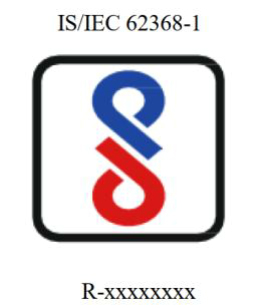
3. What is the Standard Mark requirement for products complying with IS/IEC 62368-1:2023?
Products complying with IS/IEC 62368-1:2023 shall bear the BIS Standard Mark in accordance with Regulation 6 (Labelling and Marking Requirements) and Annexures I, II and III of Scheme II of Schedule II of the BIS Conformity Assessment Regulations, 2018. An illustration is provided below for guidance purposes.
4. Are BIS-recognized laboratories available for testing as per IS/IEC 62368-1:2023?
Yes. The list of BIS-recognized laboratories is available on the BIS Laboratory Information Management System (LIMS) portal (lims.bis.gov.in). Applicants may search for recognized laboratories by entering the applicable Indian Standard number, i.e., IS/IEC 62368-1:2023.
5. If a Licence is due for renewal during the transition period, can it be renewed under the old Standards?
Yes. Renewal as per the old Standards IS 13252 (Part1) :2010 and IS 616:2017 shall be permitted up to 01 November 2028. i,e., the last date of concurrent running of IS 13252 (Part 1):2010 and IS 616:2017 with IS/IEC 62368-1:2023, in accordance with the implementation timeline notified by MeitY.
6. Should all new applications be submitted under IS/IEC 62368-1:2023?
Please refer to the Guidelines for Implementation of Migration to IS/IEC 62368-1:2023 dated 09 Mar 2026.
Applications may be processed as per IS 13252(Part1):2010 / IS 616:2017 or as per IS/IEC 62368-1:2023. Processing of Applications as per old standard shall be permitted only up to the last date of concurrent running with IS/IEC 62368-1:2023. For such cases, the applicant shall give a declaration that they will implement IS/IEC 62368-1:2023 by the last date of concurrent running. However, applicants are encouraged to submit new applications under IS/IEC 62368-1:2023. Beyond the last date of concurrent running, no new licence shall be granted under IS 13252 (Part 1):2010 or IS 616:2017, and all new applications shall be submitted under IS/IEC 62368-1:2023. If an existing licensee fails to complete migration to IS/IEC 62368-1:2023 by the last date of concurrent running, action for cancellation of the Licence and/or deletion of models from the scope of the licence, as applicable, may be initiated in accordance with the applicable BIS provisions.
7. Can new models tested as per IS/IEC 62368-1:2023 be included under an existing Licence(R-no) issued under IS 13252 (Part1) :2010 or IS 616:2017?
Yes. New models tested as per IS/IEC 62368-1:2023 may be included under an existing Licence (R-no.) issued under IS 13252 (Part 1):2010 or IS 616:2017, subject to compliance with the applicable BIS requirements. Applicants may refer to Clause 4(C) of the Guidelines for Implementation of Migration to IS/IEC 62368-1:2023 dated 09 March 2026 for detailed provisions. If an existing licensee fails to complete migration to IS/IEC 62368-1:2023 by the last date of concurrent running, action for cancellation of the Licence and/or deletion of models from the scope of the Licence, as applicable, may be initiated in accordance with the applicable BIS provisions.
8. Can one representative sample per Licence No. (R-no) be submitted for testing during migration to IS/IEC 62368-1:2023?
No. As per the Guidelines for Implementation of Migration to IS/IEC 62368-1:2023 dated 09 Mar 2026, existing licensees shall ensure conformance to IS/IEC 62368-1:2023 through submission of complete test report(s) issued by BIS recognized laboratory for all lead model(s) as per IS/IEC 62368-1:2023, in line with the revised series guidelines, in their scope of licence which had been previously tested as per IS 13252(Part1):2010 or IS 616:2017.
9. Can a lead model that has become End-of-Life (EOL) be replaced for migration purposes?
If the lead model has become End-of-Life (EOL), it may be withdrawn from the licence by the licensee. The next appropriate lead model in the same series may then be identified in accordance with the revised Series Guidelines issued by MeitY for demonstrating compliance with IS/IEC 62368-1:2023.
10. Are separate test reports required for products manufactured at different manufacturing locations?
Yes. Separate test reports are required for products manufactured at different manufacturing locations, as separate Licences are granted for each manufacturing location under the Compulsory Registration Scheme (CRS).
11. If migration to IS/IEC 62368-1:2023 affects compliance with other applicable Standards or Essential Requirements, are fresh test reports required?
Please refer Clauses 4.A.(6) and 4.A.(7) of the Guidelines for Implementation of Migration to IS/IEC 62368-1:2023 dated 09 Mar 2026.
12. Can components and the end product be tested in parallel under the migration process?
Yes. Components and the end products notified under Compulsory Registration Order (CRO) may be tested in parallel in accordance with the BIS Guidelines on Parallel Testing. Applicants may refer to the applicable guidelines issued by BIS.
13. Is any fee payable for migration to IS/IEC 62368-1:2023?
No fee is applicable for migration of already registered models covered in the scope of Licence, if applied via the Standard Revision provision available to Licensees.
14. Can a critical component complying with IS 13252 (Part 1):2010 or IS 616:2017 be accepted in the Critical Component List (CCL) after migration?
No. Clause 4.1.2 of IS/IEC 62368-1:2023 states that “Where the component, or a characteristic of a component, is a safeguard or a part of a safeguard, components shall comply with the requirements of this document or, where specified in a requirements clause, with the safety aspects of the relevant IEC component standards”. Therefore, critical components are required to comply with the requirements of IS/IEC 62368-1:2023.
Accordingly, critical components complying only with IS 13252 (Part 1):2010 or IS 616:2017 shall not be accepted in the Critical Component List (CCL). However, applicants may apply for registration of critical components and end products in parallel in accordance with the applicable BIS Parallel Testing Guidelines.
15. Is a test sample bearing the BIS Standard Mark acceptable for testing as per IS/IEC 62368-1:2023?
Models already registered in the scope of licence may bear the BIS Standard Mark. However, at the time of submission of samples of such registered models to a BIS-recognized laboratory for testing as per IS/IEC 62368-1:2023, the applicant shall declare that the models are already registered. The laboratory shall record the same in the test report.
16. Can manufacturers start testing products as per IS/IEC 62368-1:2023 before submitting the migration application?
Yes. Manufacturers may proceed with testing in accordance with the implementation guidelines and the applicable series guidelines issued for IS/IEC 62368-1:2023.
17. How should existing licensees apply for migration to IS/IEC 62368-1:2023?
Existing licensees shall submit complete test report(s) for all applicable lead model(s), identified in accordance with the revised Series Guidelines, through the Standard Revision/Amendment/Essential Requirement provision available in their BIS CRS login. The migration application shall be submitted in accordance with the Guidelines for Implementation of Migration to IS/IEC 62368-1:2023 dated 09 March 2026.
Note: These FAQs are intended for guidance only. In case of any inconsistency, the provisions of the Bureau of Indian Standards Act, 2016, the BIS Conformity Assessment Regulations, 2018, the applicable Quality Control Orders, and the Guidelines for Implementation of Migration to IS/IEC 62368-1:2023 shall prevail.